Analytics-Con-301시험유효자료완벽한덤프최신버전자료
Wiki Article
참고: Fast2test에서 Google Drive로 공유하는 무료 2026 copyright Analytics-Con-301 시험 문제집이 있습니다: https://drive.google.com/open?id=125mM1TgtsUoKhdG20km1b-DYjzxiBEq2
Fast2test의 제품들은 모두 우리만의 거대한IT업계엘리트들로 이루어진 그룹 즉 관련업계예서 권위가 있는 전문가들이 자기만의 지식과 지금까지의 경험으로 최고의 IT인증관련자료를 만들어냅니다. Fast2test의 문제와 답은 정확도 적중률이 아주 높습니다. 우리의 덤프로 완벽한copyright인증Analytics-Con-301시험대비를 하시면 되겠습니다. 이렇게 어려운 시험은 우리copyright인증Analytics-Con-301덤프로 여러분의 고민과 꿈을 한방에 해결해드립니다.
copyright Analytics-Con-301 시험요강:
| 주제 | 소개 |
|---|---|
| 주제 1 |
|
| 주제 2 |
|
| 주제 3 |
|
시험패스 가능한 Analytics-Con-301시험유효자료 덤프공부자료
Analytics-Con-301인증시험은 IT업계에 종사하고 계신 분이시라면 최근 많은 인기를 누리고 있다는 것을 알고 계실것입니다. Analytics-Con-301인증시험을 패스하여 자격증을 취득하는데 가장 쉬운 방법은 Fast2test에서 제공해드리는 Analytics-Con-301덤프를 공부하는 것입니다. copyright Analytics-Con-301덤프에 있는 문제와 답만 기억하시면 Analytics-Con-301시험을 패스하는데 많은 도움이 됩니다.덤프구매후 최신버전으로 업데이트되면 업데이트버전을 시스템 자동으로 구매시 사용한 메일주소로 발송해드려 덤프유효기간을 최대한 길게 연장해드립니다.
최신 copyright Consultant Analytics-Con-301 무료샘플문제 (Q20-Q25):
질문 # 20
A client is migrating their data warehouse. They visualize the data in workbooks hosted on Tableau Server with Tableau Data Management enabled and want to see how many workbooks will be impacted.
What should the consultant do to quickly identify how many workbooks will be impacted?
- A. Leverage the Tableau Developer API to query the workbooks' metadata.
- B. In Tableau Server, select the database from External Assets, then select the Lineage tab.
- C. Complete the migration and let users report errors as they are noticed.
- D. Open each workbook and identify the data source.
정답:B
설명:
Comprehensive and Detailed Explanation From Exact Extract:
When Tableau Data Management is enabled, Tableau Catalog provides Lineage capabilities that map connections between:
* External databases
* Tables
* Data sources
* Workbooks
* Fields
Tableau documentation states that the Lineage tab for any external asset (such as a database or table):
* Shows all connected workbooks
* Shows dependencies and impact analysis
* Allows admins to instantly assess how many analytics assets will be affected by a data warehouse migration Option A directly uses Tableau Catalog to perform exactly this task.
Option B is unnecessary because the Catalog lineage tool already provides this information without development effort.
Option C is completely inappropriate because it offers no analysis or planning.
Option D is too time-consuming and unnecessary, especially when Tableau Catalog provides an automated dependency map.
Therefore, the correct method is to use the Lineage tab in External Assets.
* Tableau Catalog lineage documentation showing how to view impacted workbooks.
* External Assets and data source dependency features in Tableau Data Management.
* Impact analysis best practices for data warehouse migration using Tableau Catalog.
질문 # 21
SIMULATION
From the desktop, open the CC workbook.
Open the City Pareto worksheet.
You need to complete the Pareto chart to show the percentage of sales compared to the percentage of cities. The chart must show references lines to visualize how the data compares to the Pareto principle.
From the File menu in Tableau Desktop, click Save.
정답:
설명:
See the complete Steps below in Explanation
Explanation:
To complete the Pareto chart in the "City Pareto" worksheet of your Tableau Desktop and add reference lines to illustrate how the data compares to the Pareto principle, follow these steps:
Open the CC Workbook and Access the Worksheet:
From the desktop, double-click on the CC workbook to open it in Tableau Desktop.
Navigate to the City Pareto worksheet by selecting its tab at the bottom of the window.
Construct the Pareto Chart:
Ensure that sales data is aggregated by city. If not, drag the 'City' dimension to the Columns shelf and the 'Sales' measure to the Rows shelf.
Sort the sales data in descending order to properly align the cities according to their sales contribution.
To create a running total of sales, right-click on the 'Sales' measure on the Rows shelf, select 'Quick Table Calculation', and choose 'Running Total'.
Drag the 'Number of Records' field to the Rows shelf next to the Sales running total. Right-click on it, select 'Quick Table Calculation', and choose 'Running Total'. Set its calculation to 'Percent of Total' from the 'Edit Table Calculation' option to represent the percentage of cities.
Add Reference Lines for the Pareto Principle:
Click on the Analytics tab in the sidebar.
Drag a 'Reference Line' element and drop it onto the chart area.
Set the Reference Line for the Sales axis at 80% to represent the typical Pareto cutoff where 80% of effects come from 20% of causes.
Add another Reference Line on the axis representing the percentage of cities, set at 20%, to visually assess the Pareto principle.
Adjust the Appearance of the Chart:
Format the reference lines by right-clicking on them, selecting 'Edit', and choosing a distinct style or color to make them stand out.
Ensure the chart is clear and labels are appropriately adjusted for easy understanding of the data visualization.
Save Your Changes:
From the File menu, click 'Save' to ensure all your changes are stored.
References:
Tableau Help: Offers detailed guidance on creating Pareto charts and adding reference lines.
Tableau Visualization Best Practices: Provides tips on effectively displaying cumulative data and principles such as Pareto.
By following these steps, you will have successfully enhanced the City Pareto worksheet to include a complete Pareto chart with reference lines that illustrate how the sales data compares to the Pareto principle, making it easier to analyze and communicate the distribution of sales across cities.
질문 # 22
A client collects information about a web browser customers use to access their website. They then visualize the breakdown of web traffic by browser version.
The data is stored in the format shown below in the related table, with a NULL BrowserID stored in the Site Visitor Table if an unknown browser version accesses their website.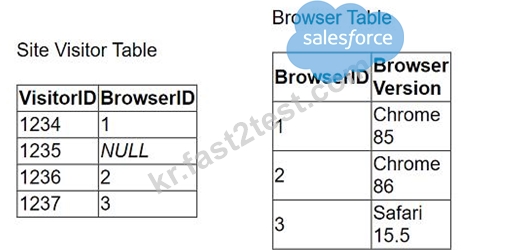
The client uses "Some Records Match" for the Referential Integrity setting because a match is not guaranteed. The client wants to improve the performance of the dashboard while also getting an accurate count of site visitors.
Which modifications to the data tables and join should the consultant recommend?
- A. Continue to use NULL as the BrowserID in the Site Visitor Table and change the Referential Integrity to "All Records Match."
- B. Add an "Unknown" option to the Browser Table, reference its BrowserID in the Site Visitor Table, and leave the Referential Integrity set to
"Some Records Match." - C. Continue to use NULL as the BrowserID in the Site Visitor Table and leave the Referential Integrity set to "Some Records Match."
- D. Add an "Unknown" option to the Browser Table, reference its BrowserID in the Site Visitor Table, and change the Referential Integrity to "All Records Match."
정답:D
설명:
To improve the performance of a Tableau dashboard while maintaining accurate counts, particularly when dealing with unknown or NULL BrowserIDs in the data tables, the following steps are recommended:
Modify the Browser Table: Add a new row to the Browser Table labeled "Unknown," assigning it a unique BrowserID, e.g., 0 or 4.
Update the Site Visitor Table: Replace all NULL BrowserID entries with the BrowserID assigned to the "Unknown" entry. This ensures every record in the Site Visitor Table has a valid BrowserID that corresponds to an entry in the Browser Table.
Change Referential Integrity Setting: Change the Referential Integrity setting from "Some Records Match" to "All Records Match." This change assumes all records in the primary table have corresponding records in the secondary table, which improves query performance by allowing Tableau to make optimizations based on this assumption.
References:
Handling NULL Values: Replacing NULL values with a valid unknown option ensures that all data is included in the analysis, and integrity between tables is maintained, thereby optimizing the performance and accuracy of the dashboard.
질문 # 23
A client calculates the percent of total sales for a particular region compared to all regions.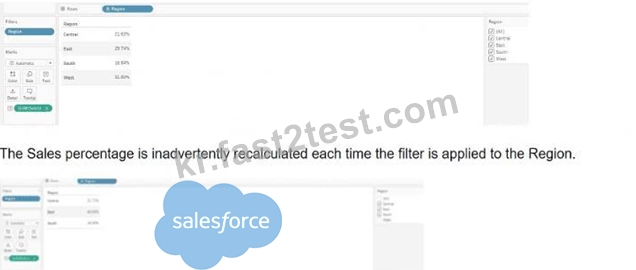
Which calculation will fix the automatic recalculation on the % of total field?
- A. {FIXED [Region]:sum([Sales])}/SUM([Sales]}
- B. {FIXED [Region]:sum([Sales])}
- C. {FIXED [Region]:sum([Sales])}/{FIXED :SUM([Sales])
- D. {FIXED [Region]:[Sales]}/{FIXED: SUM([Sales])}
정답:A
설명:
To correctly calculate the percent of total sales for a particular region compared to all regions, and to ensure that the calculation does not get inadvertently recalculated with each region filter application, the recommended calculation is:
* {FIXED [Region]: sum([Sales])}: This part of the formula computes the sum of sales for each region, regardless of any filters applied to the view. It uses a Level of Detail expression to fix the sum of sales to each region, ensuring that filtering by regions won't affect the calculated value.
* SUM([Sales]): This part computes the total sum of sales across all regions and is recalculated dynamically based on the filters applied to other parts of the dashboard or worksheet.
* Combining the two parts: By dividing the fixed regional sales by the total sales, we get the proportion of sales for each region as compared to the total. This calculation ensures that while the denominator adjusts according to filters, the numerator remains fixed for each region, accurately reflecting the sales percentage without being affected by the region filter directly.
References
This calculation follows Tableau's best practices for using Level of Detail expressions to manage computation granularity in the presence of dashboard filters, as outlined in the Tableau User Guide and official Tableau training materials.
질문 # 24
From the desktop, open the CC workbook.
Open the Incremental worksheet.
You need to add a line to the chart that
shows the cumulative percentage of sales
contributed by each product to the
incremental sales.
From the File menu in Tableau Desktop, click
Save.
정답:
설명:
See the complete Steps below in Explanation:
Explanation:
To add a line showing the cumulative percentage of sales contributed by each product to the incremental sales in the Incremental worksheet of your Tableau Desktop, follow these detailed steps:
* Open the CC Workbook and Access the Worksheet:
* From the desktop, double-click on the CC workbook to open it in Tableau Desktop.
* Navigate to the Incremental worksheet by clicking on its tab at the bottom of the window.
* Calculate Cumulative Sales Percentage:
* Create a new calculated field to compute the cumulative percentage of sales. Right-click in the Data pane and select 'Create Calculated Field'.
* Name this field "Cumulative Sales Percentage".
* Enter the following formula to calculate the running sum of sales as a percentage of the total sales:
(RUNNING_SUM(SUM([Sales])) / TOTAL(SUM([Sales])) [Sales]))
* Click 'OK' to save the calculated field.
* Add the Cumulative Sales Percentage Line to the Chart:
* Drag the "Cumulative Sales Percentage" field to the Rows shelf, placing it next to the existing Sales measure.
* Ensure that the cumulative line appears as a continuous line. Right-click on the "Cumulative Sales Percentage" field on the Rows shelf, select 'Change Chart Type', and choose 'Line'.
* Adjust the axis to synchronize or dual-axis if necessary. Right-click on the axis of the
"Cumulative Sales Percentage" and select 'Synchronize Axis' if it's on a dual-axis setup.
* Format the Cumulative Sales Percentage Line:
* Click on the "Cumulative Sales Percentage" line in the visualization.
* Navigate to the 'Format' pane to adjust the line style, thickness, and color to make it distinct from other data in the chart.
* Save Your Changes:
* From the File menu, click 'Save' to ensure all your changes are stored.
References:
Tableau Help: Provides additional details on creating calculated fields and customizing line charts.
Tableau User Guide: Offers extensive instructions on formatting charts, including line types and axis synchronization.
By following these steps, you will successfully add a cumulative sales percentage line to your chart, enhancing the visualization to reflect the incremental contribution of each product to the overall sales in a dynamic and informative manner.
질문 # 25
......
copyright Analytics-Con-301인증시험패스 하는 동시에 여러분의 인생에는 획기적인 일 발생한것이죠, 사업에서의 상승세는 당연한것입니다. IT업계종사자라면 누구나 이런 자격증을 취득하고싶어하리라고 믿습니다. 많은 분들이 이렇게 좋은 인증시험은 아주 어렵다고 생각합니다. 네 많습니다. 패스할확율은 아주 낮습니다. 노력하지않고야 당연히 불가능하죠.copyright Analytics-Con-301시험은 기초지식 그리고 능숙한 전업지식이 필요요 합니다. 우리Fast2test는 여러분들한테copyright Analytics-Con-301시험을 쉽게 빨리 패스할 수 있도록 도와주는 사이트입니다. 우리Fast2test의copyright Analytics-Con-301시험관련자료로 여러분은 짧은시간내에 간단하게 시험을 패스할수 있습니다. 시간도 절약하고 돈도 적게 들이는 이런 제안은 여러분들한테 딱 좋은 해결책이라고 봅니다.
Analytics-Con-301인증공부문제: https://kr.fast2test.com/Analytics-Con-301-premium-file.html
- 시험패스에 유효한 최신버전 Analytics-Con-301시험유효자료 시험대비자료 ???? 오픈 웹 사이트➠ www.pass4test.net ????검색➥ Analytics-Con-301 ????무료 다운로드Analytics-Con-301시험대비 덤프 최신 샘플
- Analytics-Con-301시험유효자료 덤프문제모음집 ???? 지금[ www.itdumpskr.com ]에서[ Analytics-Con-301 ]를 검색하고 무료로 다운로드하세요Analytics-Con-301시험대비 덤프 최신 샘플
- Analytics-Con-301인기자격증 덤프공부문제 ???? Analytics-Con-301시험대비 덤프 최신 샘플 ◀ Analytics-Con-301최고패스자료 ???? “ www.pass4test.net ”에서▶ Analytics-Con-301 ◀를 검색하고 무료 다운로드 받기Analytics-Con-301최신덤프문제
- 최신 Analytics-Con-301덤프,Analytics-Con-301시험의 모든 내용을 덮고 있습니다. ✌ ✔ www.itdumpskr.com ️✔️을(를) 열고☀ Analytics-Con-301 ️☀️를 입력하고 무료 다운로드를 받으십시오Analytics-Con-301높은 통과율 시험공부
- Analytics-Con-301인기자격증 덤프공부문제 ???? Analytics-Con-301높은 통과율 시험대비 공부문제 ???? Analytics-Con-301높은 통과율 시험공부 ???? 【 www.exampassdump.com 】웹사이트를 열고➡ Analytics-Con-301 ️⬅️를 검색하여 무료 다운로드Analytics-Con-301최신 인증시험 대비자료
- Analytics-Con-301인기자격증 덤프공부자료 ???? Analytics-Con-301최신덤프문제 ???? Analytics-Con-301최신시험 ???? 《 www.itdumpskr.com 》을(를) 열고➡ Analytics-Con-301 ️⬅️를 입력하고 무료 다운로드를 받으십시오Analytics-Con-301시험대비 덤프 최신 샘플
- Analytics-Con-301시험유효자료 덤프문제모음집 ???? 무료로 다운로드하려면“ www.exampassdump.com ”로 이동하여▶ Analytics-Con-301 ◀를 검색하십시오Analytics-Con-301최신 인증시험 대비자료
- 최신 Analytics-Con-301시험유효자료 시험덤프 ???? ➽ www.itdumpskr.com ????에서☀ Analytics-Con-301 ️☀️를 검색하고 무료 다운로드 받기Analytics-Con-301높은 통과율 시험덤프자료
- Analytics-Con-301최신버전자료 ???? Analytics-Con-301시험덤프 ???? Analytics-Con-301시험대비 최신 덤프모음집 ???? 검색만 하면➤ www.pass4test.net ⮘에서[ Analytics-Con-301 ]무료 다운로드Analytics-Con-301인기자격증 시험 덤프자료
- Analytics-Con-301인기자격증 덤프공부자료 ???? Analytics-Con-301시험덤프 ???? Analytics-Con-301시험대비 최신 공부자료 ???? ⏩ www.itdumpskr.com ⏪에서⇛ Analytics-Con-301 ⇚를 검색하고 무료 다운로드 받기Analytics-Con-301시험대비 덤프 최신 샘플
- 최신 Analytics-Con-301시험유효자료 시험덤프 ???? ▶ kr.fast2test.com ◀의 무료 다운로드《 Analytics-Con-301 》페이지가 지금 열립니다Analytics-Con-301퍼펙트 덤프 최신 데모문제
- heathocqr169789.empirewiki.com, ambereywq498157.empirewiki.com, arundhft252202.nizarblog.com, lancetber513106.wiki-racconti.com, jesseklpn379775.blogripley.com, roryoair466977.bloggosite.com, myportal.utt.edu.tt, myportal.utt.edu.tt, myportal.utt.edu.tt, myportal.utt.edu.tt, myportal.utt.edu.tt, myportal.utt.edu.tt, myportal.utt.edu.tt, myportal.utt.edu.tt, myportal.utt.edu.tt, myportal.utt.edu.tt, philipgoxs916951.wiki-racconti.com, minagumu800796.homewikia.com, yesbookmarks.com, Disposable vapes
그리고 Fast2test Analytics-Con-301 시험 문제집의 전체 버전을 클라우드 저장소에서 다운로드할 수 있습니다: https://drive.google.com/open?id=125mM1TgtsUoKhdG20km1b-DYjzxiBEq2
Report this wiki page